The Contradiction of Being a Therapist While Navigating Family Dysfunction
People assume therapists have it all together.
That because we understand trauma, communication, attachment, boundaries, and healing, our personal lives must naturally reflect peace and emotional balance. They assume that because we can guide others through pain, we somehow become immune to our own.
But the truth is, many therapists are still human beings trying to survive the very things we help others heal from.
And for Black women therapists specifically, the contradiction can feel even heavier.
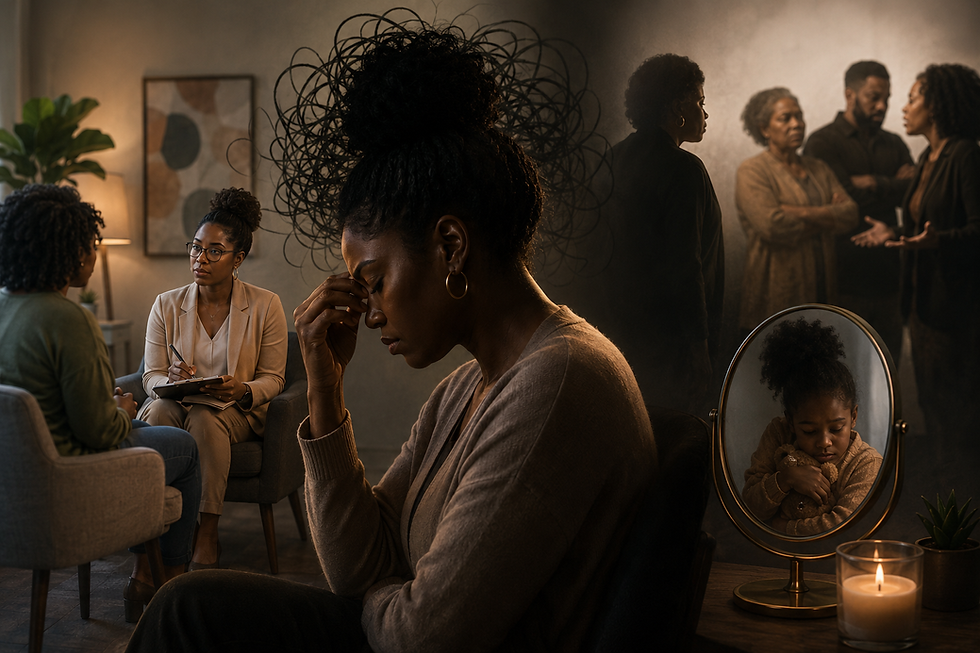
We are often the “strong one” in our families. The peacemaker. The fixer. The emotionally aware one. The one people call when everything falls apart. We carry generations of survival, silence, sacrifice, and unspoken pain while simultaneously being trained to identify dysfunction in clinical settings.
Imagine sitting in sessions teaching healthy communication while your own family avoids difficult conversations.
Imagine helping clients establish boundaries while your own boundaries are labeled disrespectful.
Imagine understanding trauma responses academically, clinically, and spiritually, while still being triggered by the same family dynamics you thought you healed from.
That is the contradiction.
Being a therapist does not erase the daughter in you. It does not erase the child in you. It does not erase the wounds created before you had the language to explain them.
Sometimes the hardest part of being a therapist is recognizing dysfunction clearly while still grieving the fact that the people you love may never acknowledge it.
There is a special kind of exhaustion that comes from being emotionally intelligent in emotionally immature environments.
You notice everything. The manipulation. The avoidance. The generational patterns. The normalized chaos. The unspoken grief. The way survival became more valued than healing.
And yet, despite all the knowledge, all the education, and all the clinical training, you still find yourself wanting what every child wants:
To feel seen. To feel safe. To feel chosen. To feel loved correctly.
That is the part people do not talk about enough.
Therapists are not detached from pain. Sometimes we became therapists because pain introduced itself to us early. Because we had to learn people before we learned ourselves. Because we grew up navigating emotional instability and became experts at reading rooms, tones, and behaviors just to survive.
For many Black women, therapy is not just a profession. It is both purpose and survival.
And still, healing within family systems can feel impossible when dysfunction has become identity.
Sometimes family members confuse accountability with disrespect. Sometimes boundaries are interpreted as abandonment. Sometimes growth threatens people who benefited from your silence.
That reality hurts.
Because no amount of education prepares you for the heartbreak of realizing you cannot heal people who do not want healing.
The contradiction is this:
You can help others process trauma while still processing your own. You can teach emotional regulation while still having moments where your inner child aches. You can be professionally healthy while personally grieving. You can be a therapist and still be tired.
And maybe that does not make you a hypocrite. Maybe it makes you human.
Maybe healing is not about becoming untouched by dysfunction. Maybe healing is learning how to stop letting dysfunction define you.
For the therapists silently carrying family pain while helping everyone else carry theirs:
You deserve support too.
You deserve softness too.
You deserve healing too.
And you are allowed to acknowledge the contradiction without shame.


Comments